Employee onboarding is one of the most critical stages in the employee lifecycle. A well-designed onboarding program helps new hires understand their roles, connect with the company culture, and become productive faster. Yet many organizations still rely on traditional onboarding methods that often struggle to engage today’s workforce.
In recent years, gamified employee onboarding has emerged as a modern alternative, transforming routine orientation activities into interactive and rewarding learning experiences. But does gamification truly outperform traditional onboarding?
This article compares traditional and gamified employee onboarding across key parameters to help organizations determine which approach is more effective.
What Is Traditional Employee Onboarding?
Traditional onboarding typically consists of:
- Classroom training sessions
- PowerPoint presentations
- Employee handbooks and policy documents
- Instructor-led orientation programs
- Videos followed by assessments
- Job shadowing and mentoring
The primary goal is to transfer information about company policies, processes, culture, and job responsibilities.
While traditional onboarding has been widely used for decades, it often follows a one-size-fits-all approach that may not resonate with modern learners.
What Is Gamified Employee Onboarding?
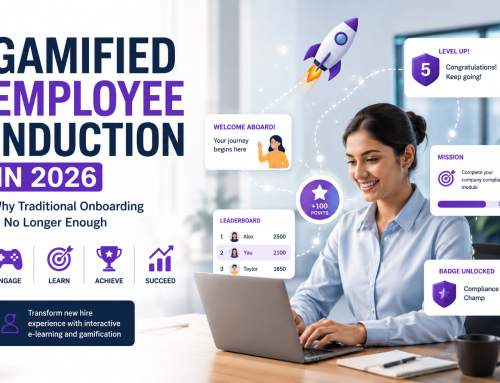
Gamified onboarding incorporates game elements into the onboarding process to make learning more engaging and interactive.
Common gamification elements include:
- Points and rewards
- Badges and achievements
- Leaderboards
- Levels and progression systems
- Interactive challenges
- Scenario-based missions
- Quests and learning journeys
- Instant feedback
The objective is not to turn onboarding into a game but to use proven motivational techniques to increase participation, retention, and completion rates.
Comparing Traditional and Gamified Employee Onboarding
1. Employee Engagement
Traditional Onboarding
Many traditional onboarding programs involve lengthy presentations and extensive reading materials. New hires often receive a large amount of information within a short period, leading to cognitive overload.
As a result:
- Attention levels drop quickly
- Participation becomes passive
- Employees may struggle to stay focused
Gamified Onboarding
Gamification transforms learning into an active experience. Employees participate in challenges, solve problems, earn rewards, and track progress.
Benefits include:
- Higher engagement levels
- Increased participation
- Greater motivation to complete training
Winner: Gamified Onboarding
2. Knowledge Retention
Traditional Onboarding
Employees frequently forget a significant portion of information delivered during orientation sessions because much of the learning is passive.
Challenges include:
- Information overload
- Limited reinforcement
- Low interaction levels
Gamified Onboarding
Gamification improves retention by encouraging active learning and repeated practice. Scenario-based activities allow employees to apply concepts rather than simply read about them.
Benefits include:
- Better recall of information
- Improved understanding
- Enhanced long-term retention
Winner: Gamified Onboarding
3. Learning Experience
Traditional Onboarding
Traditional onboarding often focuses on information delivery rather than learner experience.
Employees may perceive training as:
- Mandatory
- Repetitive
- Time-consuming
Gamified Onboarding
Gamification introduces elements of achievement, challenge, and exploration.
Employees experience:
- A sense of accomplishment
- Continuous progression
- More enjoyable learning
This creates a positive first impression of the organization.
Winner: Gamified Onboarding
4. Speed to Productivity
Traditional Onboarding
When onboarding relies heavily on presentations and manuals, employees may take longer to apply knowledge in real workplace situations.
Gamified Onboarding
Interactive simulations and realistic scenarios enable employees to practice job-related tasks before performing them in real situations.
This helps employees:
- Build confidence faster
- Understand workflows more effectively
- Become productive sooner
Winner: Gamified Onboarding
5. Scalability
Traditional Onboarding
Instructor-led programs often require:
- Trainers
- Physical facilities
- Scheduling coordination
Scaling onboarding across multiple locations can be challenging.
Gamified Onboarding
Digital gamified onboarding modules can be deployed globally with minimal additional effort.
Advantages include:
- Consistent learning experiences
- Easy updates
- Lower administrative burden
Winner: Gamified Onboarding
6. Cost Considerations
Traditional Onboarding
Traditional onboarding may involve recurring expenses such as:
- Trainer fees
- Travel costs
- Venue expenses
- Printed materials
Gamified Onboarding
The initial development investment may be higher, but organizations can often reduce recurring delivery costs over time.
Benefits include:
- Reusable content
- Reduced trainer dependency
- Easier distribution
Winner: Depends on Organizational Needs
Small organizations may find traditional onboarding more economical initially, while larger organizations often achieve better long-term ROI through gamification.
7. Employee Motivation
Traditional Onboarding
Motivation often depends on the trainer’s effectiveness and the employee’s personal interest.
Gamified Onboarding
Game mechanics create intrinsic and extrinsic motivation through:
- Recognition
- Rewards
- Progress tracking
- Achievement systems
Employees are encouraged to continue learning and complete onboarding activities.
Winner: Gamified Onboarding
8. Measurement and Analytics
Traditional Onboarding
Tracking engagement and learning outcomes can be difficult.
Organizations often rely on:
- Attendance records
- Manual assessments
- Feedback forms
Gamified Onboarding
Modern gamified platforms provide detailed analytics such as:
- Completion rates
- Assessment scores
- Time spent on activities
- Progress tracking
- Knowledge gaps
This data enables continuous improvement.
Winner: Gamified Onboarding
Situations Where Traditional Onboarding Still Works Well
Despite the advantages of gamification, traditional onboarding remains valuable in certain situations:
Small Organizations
Companies with limited hiring volumes may find traditional onboarding sufficient.
Relationship Building
Face-to-face interactions help new hires build personal connections with managers and colleagues.
Complex Discussions
Topics requiring nuanced conversations, such as organizational culture, leadership expectations, or strategic direction, are often better suited to live sessions.
Executive Onboarding
Senior leaders may benefit from personalized onboarding rather than highly gamified experiences.
The Best Approach: A Hybrid Model
For many organizations, the most effective solution is not choosing one approach over the other but combining both.
A hybrid onboarding model might include:
Traditional Components
- Welcome sessions
- Manager introductions
- Team interactions
- Mentoring programs
Gamified Components
- Compliance training
- Product knowledge
- Process training
- Policy learning
- Scenario-based assessments
This approach combines the human connection of traditional onboarding with the engagement and effectiveness of gamification.
Key Benefits of Gamified Employee Onboarding
Organizations adopting gamified onboarding often report improvements in:
- Employee engagement
- Knowledge retention
- Training completion rates
- Learner satisfaction
- Time-to-productivity
- Consistency across locations
- Training analytics and reporting
These benefits can contribute to stronger employee experiences and improved onboarding outcomes.
Final Verdict
When evaluated across engagement, retention, motivation, scalability, and learning effectiveness, gamified employee onboarding generally outperforms traditional onboarding.
However, traditional onboarding still plays an important role in building relationships, communicating culture, and facilitating meaningful discussions.
Rather than viewing the two approaches as competitors, organizations should leverage the strengths of both. A blended onboarding strategy that combines personal interaction with gamified learning experiences often delivers the best results.
As employee expectations continue to evolve, organizations that create engaging, interactive, and memorable onboarding experiences will be better positioned to accelerate productivity, improve retention, and help new hires succeed from day one.