Introduction

The risk landscape across the Banking, Financial Services, and Insurance (BFSI) sector has become significantly more complex over the past few years. Financial institutions are no longer dealing solely with traditional operational and regulatory risks. Today, they must navigate AI-enabled fraud, sophisticated cyberattacks, digital lending risks, real-time payment fraud, evolving Anti-Money Laundering (AML) techniques, third-party technology dependencies, data privacy regulations, and increasing customer expectations.

To manage these challenges, organizations have invested heavily in technology. Artificial intelligence detects suspicious transactions, fraud monitoring systems identify anomalies, Governance, Risk, and Compliance (GRC) platforms automate controls, and Security Operations Centers (SOCs) continuously monitor cyber threats.

Yet despite these investments, many risk incidents still originate from a familiar source, which is the human decision-making.

An employee overlooks an unusual transaction.

A relationship manager bypasses a control to satisfy an important customer.

A claims processor misses indicators of insurance fraud.

A credit officer approves a loan despite inconsistent financial information.

A staff member unknowingly shares confidential data with an unauthorized third party.

These incidents rarely occur because employees are unaware of organizational policies. More often, they occur because traditional training does not adequately prepare employees for the situations they encounter in their day-to-day roles.

Risk management training across much of the BFSI sector continues to rely on presentations, policy documents, videos, and multiple-choice assessments. While these methods communicate regulations effectively, they often fail to develop the judgement, analytical thinking, and decision-making skills required to identify and respond to risks in real business environments.

This is where gamification is beginning to reshape risk management training.

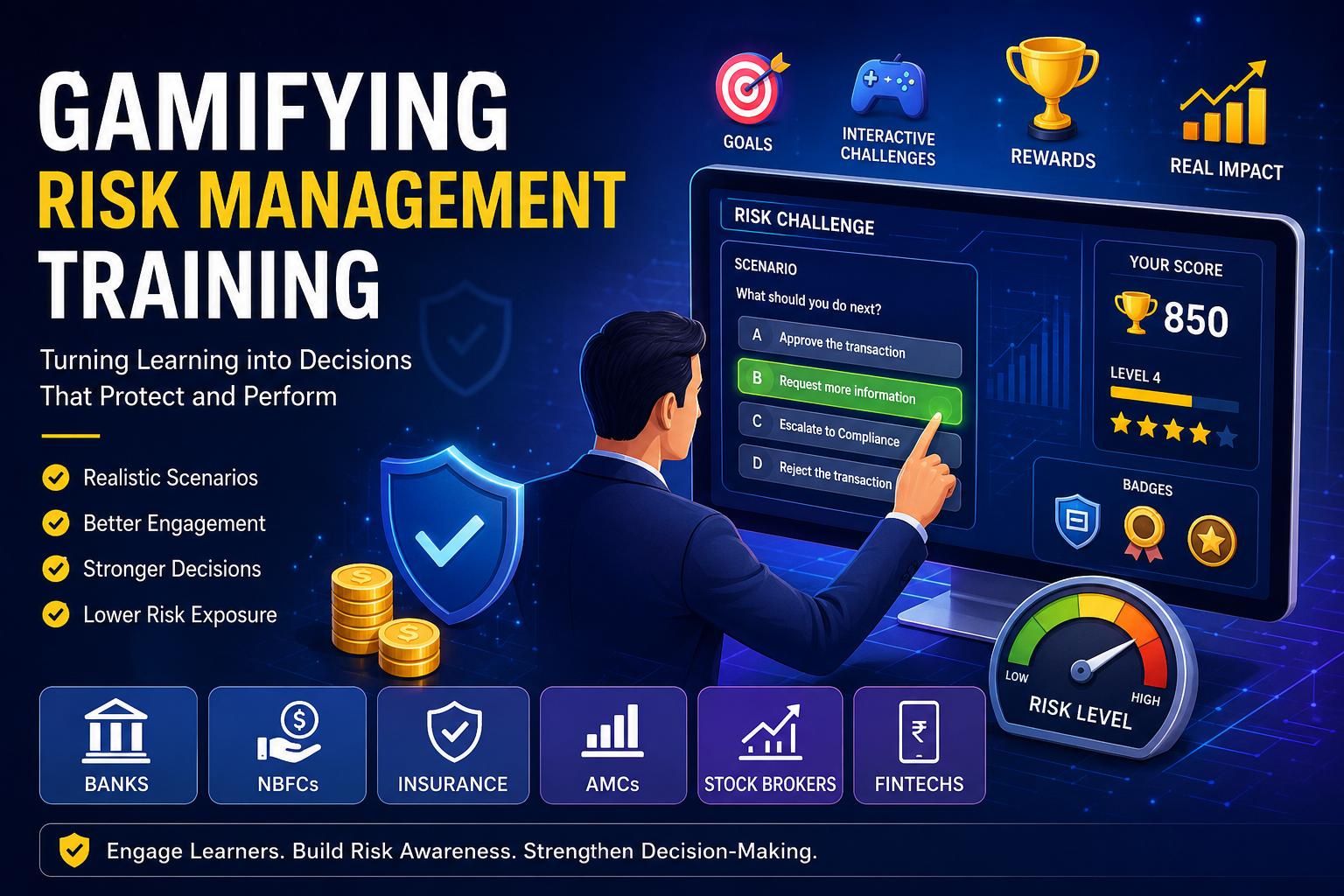
Rather than asking employees to memorize policies, gamified learning places them inside realistic scenarios where they investigate fraud, assess credit applications, respond to cyber incidents, evaluate customer behaviour, identify compliance risks, and experience the consequences of every decision they make.

The objective is not to make learning entertaining.

The objective is to prepare employees for the increasingly complex risk decisions they make every day.

Why Risk Management Training Needs to Evolve

Most organizations consider training to be one of the foundational elements of their risk management framework. New employees complete induction, annual compliance certifications, cybersecurity awareness modules, AML refresher courses, fraud awareness sessions, and periodic policy updates.

These learning initiatives undoubtedly improve awareness.

However, awareness alone does not always translate into better decision-making.

Consider how most risk management courses are delivered.

Employees typically read policies, watch explanatory videos, complete short assessments, and receive a completion certificate.

Unfortunately, the workplace rarely presents risks in such a structured manner.

Instead, employees receive incomplete information, conflicting priorities, commercial pressure, and limited time to make decisions.

A relationship manager may need to decide whether a transaction should be escalated.

A claims assessor may have to determine whether inconsistencies in submitted documents justify further investigation.

A loan officer may need to evaluate an applicant whose financial records appear genuine but contain subtle warning signs.

These are situations where judgement matters more than memorization.

Risk management training must therefore evolve from knowledge transfer to capability development.

Employees need opportunities to practice recognizing risks, analyzing information, evaluating alternatives, and making decisions before similar situations arise in the real world.

Gamification Is About Building Experience

One of the biggest misconceptions surrounding gamification is that it simply means adding points, badges, or leaderboards to online learning.

While these elements may improve participation, they do not necessarily improve decision-making.

Effective gamification focuses on creating experiences.

Think about aviation.

Commercial pilots spend hundreds of hours inside flight simulators before flying passengers. They repeatedly practise responding to engine failures, equipment malfunctions, severe weather, and emergency landings until the correct response becomes second nature.

Healthcare professionals train using simulated emergencies before treating patients independently.

Military personnel conduct realistic field exercises before deployment.

Financial institutions face a similar challenge.

Employees responsible for customer onboarding, lending, fraud investigations, cybersecurity, investment advisory, claims assessment, and regulatory compliance often make decisions that directly affect customers, financial performance, and institutional reputation.

Instead of learning through costly real-world mistakes, they should have opportunities to practise these decisions within safe, immersive environments.

That is precisely where gamification delivers value.

Instead of reading about fraud, employees investigate it.

Instead of studying cyber threats, they respond to them.

Instead of memorizing AML procedures, they analyze suspicious customer behaviour.

Learning becomes active rather than passive.

Banks: Transforming Risk Management Training Across the Organization

Banks operate across one of the broadest risk environments within the financial sector.

Branch operations, treasury, retail banking, corporate banking, payments, digital banking, trade finance, wealth management, and customer servicing each expose employees to different categories of risk.

A generic risk management course rarely prepares employees for the complexity of these roles.

Gamified training can make learning significantly more practical by recreating situations employees encounter throughout the banking ecosystem.

Operational Risk Training

Operational risk training often explains internal controls, maker-checker processes, exception management, and escalation procedures.

Gamification allows employees to experience these controls in action.

Imagine a learner managing a busy branch on the last working day of the month.

Customer queues continue growing.

The core banking application is responding slowly.

A senior customer requests immediate processing of a high-value transaction despite incomplete documentation.

At the same time, the branch receives multiple cash deposits requiring verification.

The learner must prioritize work, follow operational controls, decide whether to escalate exceptions, and manage customer expectations.

Each decision influences customer satisfaction, operational efficiency, compliance outcomes, and financial exposure.

Instead of reading operational policies, employees understand why these controls exist.

AML Training

Anti-Money Laundering training becomes considerably more engaging when employees investigate customer behaviour instead of memorizing regulations.

A customer regularly deposits cash amounts just below reporting thresholds.

Several business accounts appear unrelated but share common contact details.

A politically exposed person attempts to onboard using a complex ownership structure.

The learner analyses customer information, transaction patterns, beneficial ownership records, and sanctions screening results before deciding whether enhanced due diligence or escalation is required.

This investigative approach develops analytical thinking rather than procedural recall.

Fraud Risk Training

Fraud prevention requires employees to identify behavioral patterns rather than isolated warning signs.

A gamified fraud investigation begins with a seemingly routine complaint.

As learners review transaction histories, approval records, customer communications, and internal system logs, additional evidence gradually emerges.

Some clues suggest identity theft.

Others indicate employee collusion.

Additional information reveals possible account takeover.

The learner determines how the investigation progresses.

By the end of the simulation, employees understand not only how fraud occurs but also how seemingly minor observations can prevent substantial financial losses.

Cybersecurity Awareness Training

Cybersecurity training often struggles to recreate the urgency of actual cyber incidents.

Gamification changes this completely.

Employees receive realistic phishing emails, suspicious QR codes, fake software updates, unexpected payment requests, and unusual login alerts.

Every decision shapes the outcome.

A single incorrect action may compromise customer information or trigger a ransomware attack.

Correct decisions contain the incident before business operations are affected.

This practical experience significantly improves employees’ ability to recognize cyber threats outside the classroom.

Conduct and Ethics Training

Conduct risk remains one of the most challenging training areas because ethical decisions are rarely black and white.

Imagine a relationship manager nearing quarterly sales targets.

A customer requests an investment product that is clearly unsuitable based on their financial objectives.

Recommending an alternative product serves the customer’s interests but affects revenue targets.

The learner must balance commercial objectives with ethical responsibilities.

As the scenario unfolds, employees witness the long-term consequences of unsuitable advice, customer complaints, regulatory investigations, and reputational damage.

Rather than simply reading the Code of Conduct, employees practice applying it.

NBFCs: Making Lending and Credit Risk Training More Practical

Non-Banking Financial Companies operate within a different risk environment from traditional banks.

Credit quality, collections, digital lending, customer onboarding, fraud prevention, and regulatory compliance remain central to sustainable business growth.

Gamified learning helps employees experience these situations before they encounter them in live business operations.

Credit Underwriting Training

Evaluating credit applications involves balancing growth with responsible lending.

A learner receives a loan application supported by income documents, bank statements, GST filings, credit bureau reports, collateral information, and business financials.

At first glance, the application appears acceptable.

However, deeper analysis reveals inconsistencies in cash flows, sudden increases in turnover, and discrepancies between declared income and transaction behaviour.

Should the loan be approved?

Should additional documentation be requested?

Should the application be declined?

Each decision affects future portfolio quality, default rates, and business performance.

Employees begin understanding that successful underwriting depends on careful analysis rather than processing speed.

Digital Lending Risk Training

As digital lending expands, new risks emerge around digital identity, customer consent, algorithmic decision-making, privacy, and remote verification.

A borrower successfully completes digital KYC.

However, device intelligence indicates suspicious behaviour.

Location data conflicts with previous applications.

The applicant repeatedly modifies financial information during submission.

Employees participating in the simulation evaluate whether additional verification is required before approval.

These exercises prepare lending teams for risks that traditional classroom training often struggles to explain.

Collections and Customer Treatment Training

Collections professionals regularly balance recovery objectives with regulatory expectations and customer sensitivity.

Imagine a borrower experiencing genuine financial hardship following a medical emergency.

The learner must choose whether to restructure the loan, negotiate repayment terms, initiate legal proceedings, or escalate the case for further review.

Each decision influences customer relationships, recovery outcomes, regulatory compliance, and institutional reputation.

The simulation reinforces that responsible collections involve both commercial judgement and fair customer treatment.

Insurance: Turning Risk Management Training into Real-World Decision Making

Insurance companies operate in an environment where every decision has financial consequences. Whether assessing a new proposal, investigating a claim, or advising a customer, employees constantly evaluate uncertainty. Traditional training explains underwriting guidelines, claims procedures, fraud indicators, and regulatory requirements, but it often struggles to prepare employees for the complexity of real customer situations.

Gamification helps bridge this gap by allowing employees to apply their knowledge in realistic business scenarios.

Underwriting Risk Training

Risk assessment is at the heart of insurance underwriting. Every proposal requires underwriters to analyse customer disclosures, medical history, property inspections, financial information, and policy conditions before determining the level of acceptable risk.

Instead of studying underwriting manuals, learners can evaluate simulated proposals where every application contains subtle warning signs.

A customer applying for health insurance has omitted previous medical treatments. A commercial property insurance proposal includes incomplete fire safety documentation. A motor insurance application contains inconsistencies between vehicle ownership records and inspection reports.

Learners must identify missing information, assess the level of exposure, decide whether to seek additional clarification, apply policy exclusions, or decline the proposal altogether.

The simulation demonstrates how underwriting decisions influence future claims experience, portfolio profitability, and customer outcomes, helping employees understand that sound underwriting is built on careful judgement rather than speed.

Claims Management and Fraud Risk Training

Claims handling represents one of the most critical customer interactions in the insurance industry. Every claim requires employees to balance customer service with fraud prevention.

Gamified learning allows claims professionals to investigate complex cases rather than simply reviewing fraud indicators.

For example, a motor accident claim initially appears straightforward. As learners review photographs, repair estimates, police reports, GPS records, medical documentation, and previous claim histories, inconsistencies begin to emerge.

Do the photographs match the reported accident?

Has the same repair workshop appeared in previous suspicious claims?

Do the medical records support the reported injuries?

Rather than memorising fraud typologies, employees develop investigative thinking by analysing evidence and making decisions that affect claim outcomes.

Customer Advisory and Sales Risk Training

Insurance advisors often face situations where commercial targets and customer interests compete.

Interactive simulations can recreate customer conversations involving product suitability, disclosure requirements, replacement of existing policies, and long-term financial planning.

Learners experience how inappropriate recommendations may result in customer complaints, regulatory scrutiny, reputational damage, and policy cancellations.

By practising these conversations repeatedly, advisors develop confidence in balancing ethical sales practices with business objectives.

Asset Management Companies: Strengthening Market Conduct Through Immersive Learning

Asset Management Companies (AMCs) operate in one of the most highly regulated segments of the financial sector. Portfolio managers, dealers, research analysts, relationship managers, compliance professionals, and investor servicing teams all influence investor confidence and market integrity.

Risk management training within AMCs must therefore go beyond regulations and help employees understand how their everyday decisions can affect investors and financial markets.

Prevention of Market Abuse Training

Market abuse training often focuses on legal definitions, making it difficult for employees to recognise violations in practice.

Gamified learning allows participants to experience realistic market situations where information is incomplete and decisions must be made quickly.

A research analyst receives information during discussions with company management before it becomes public.

A dealer notices unusually large client orders ahead of a major market announcement.

A portfolio manager is invited to an industry event where confidential information is discussed informally.

Learners evaluate each situation and determine the appropriate course of action while experiencing the regulatory and reputational consequences of poor decisions.

Rather than memorising prohibited practices, employees learn how market abuse develops in everyday business situations.

Investment Suitability Training

Relationship managers and investment advisors regularly recommend products to investors with varying financial goals and risk appetites.

A gamified learning experience may present customers approaching retirement, first-time investors, or experienced high-net-worth individuals with different investment objectives.

Employees assess financial goals, investment horizons, liquidity requirements, and risk tolerance before recommending suitable products.

As markets fluctuate during the simulation, learners observe how investment recommendations influence customer satisfaction, long-term relationships, and regulatory obligations.

Conflict of Interest Training

Conflicts of interest are often subtle and difficult to recognise.

Interactive scenarios can challenge employees with situations involving gifts, outside business interests, personal investments, research independence, or confidential information.

Rather than asking employees to acknowledge a policy, simulations help them identify situations where personal judgement becomes essential.

Stock Brokers: Making Market Conduct Training More Engaging

The brokerage industry operates in a fast-moving environment where market behaviour changes within seconds.

Employees working in trading, dealing, surveillance, and research must recognise inappropriate market activity before it develops into regulatory breaches.

Gamification transforms market conduct training into interactive surveillance exercises.

Participants monitor simulated trading activity, review order books, analyse transaction patterns, and investigate unusual market movements.

Throughout the exercise they identify practices such as:

  • Front-running
  • Circular trading
  • Spoofing
  • Layering
  • Wash trades
  • Client order manipulation

Each correct observation unlocks additional information while incorrect decisions demonstrate how market abuse can escalate if warning signs are ignored.

This approach develops analytical thinking far more effectively than reviewing regulations alone.

Fintech: Modernising Risk Management Training for Digital Financial Services

Fintech companies continue introducing new products, technologies, and customer experiences at remarkable speed. Alongside innovation come new categories of operational, regulatory, technology, and cyber risk.

Traditional classroom training often struggles to keep pace.

Gamified learning provides an agile way to prepare employees for rapidly evolving digital risks.

AI Risk Management Training

Artificial Intelligence is becoming part of customer onboarding, fraud detection, credit underwriting, document processing, and customer support.

Employees increasingly interact with AI-generated outputs that require human oversight.

Interactive simulations can present situations where an AI model recommends approving a loan despite unusual transaction behaviour or produces an inaccurate summary of regulatory requirements.

Learners must decide when AI recommendations should be accepted, verified, challenged, or escalated.

The objective is not to discourage AI adoption but to reinforce responsible human oversight.

API and Third-Party Risk Training

Modern fintech ecosystems depend on payment gateways, cloud providers, digital identity platforms, aggregators, and technology partners.

A simulation may challenge employees to evaluate third-party security reports, investigate unusual API traffic, respond to service disruptions, or assess vendor-related cyber risks before customer services are affected.

Such scenarios help technology and business teams understand that third-party risk management extends well beyond contractual agreements.

Digital Fraud Training

Digital fraud evolves continuously.

Instead of reading about fraud techniques, employees investigate realistic cases involving:

  • UPI fraud
  • QR-code scams
  • SIM swapping
  • Device spoofing
  • Account takeover
  • Synthetic identities
  • Merchant onboarding fraud

Learners connect customer information, device intelligence, transaction histories, and behavioural analytics to determine whether fraudulent activity is taking place.

This investigative approach builds stronger analytical capability while keeping training aligned with emerging financial crime trends.

Enterprise-Wide Risk Simulations: Breaking Departmental Silos

One of the greatest advantages of gamification is its ability to bring multiple business functions together.

Most significant business incidents affect far more than a single department.

A ransomware attack impacts technology teams, operations, legal, compliance, customer service, communications, and executive leadership.

A major fraud investigation may involve branch operations, AML teams, internal audit, fraud investigators, legal departments, and customer support.

A large-scale data breach requires coordinated action across information security, privacy, technology, risk management, communications, and regulatory reporting teams.

Gamified enterprise simulations allow these departments to train together rather than in isolation.

Participants understand not only their own responsibilities but also how decisions made by one function influence every other part of the organization.

These collaborative exercises strengthen communication, escalation procedures, crisis management, and organizational resilience while reinforcing the importance of cross-functional decision-making.

Measuring the Effectiveness of Gamified Risk Management Training

Risk management training should not be evaluated solely on course completion or assessment scores.

The real objective is to determine whether employees are becoming better at identifying, assessing, and responding to risk.

Modern gamified learning platforms provide richer insights by measuring behavioural outcomes such as:

  • Accuracy of risk identification
  • Quality of decision-making
  • Investigation capability
  • Escalation behaviour
  • Pattern recognition
  • Ethical judgement
  • Crisis response effectiveness
  • Collaboration during simulations
  • Improvement across repeated scenarios

These metrics provide learning teams and risk leaders with a more meaningful understanding of workforce readiness than traditional pass-or-fail assessments.

The Future of Risk Management Training in BFSI

As financial services become increasingly digital, the nature of risk management training will continue to evolve.

Artificial Intelligence will personalise simulations based on job roles, previous learning performance, and emerging business risks.

A relationship manager may receive customer suitability scenarios.

An AML analyst may investigate increasingly sophisticated money laundering networks.

Claims investigators may encounter new insurance fraud techniques.

Cybersecurity teams may respond to AI-enabled phishing attacks and ransomware incidents.

Rather than delivering identical annual courses to every employee, organizations will provide continuous, role-specific learning experiences that evolve alongside the business.

The focus will gradually shift from knowledge acquisition to capability development and gamifying risk management training just does that.

Conclusion

The future of risk management training in the BFSI sector lies not in delivering more policies or longer presentations, but in creating learning experiences that prepare employees for the complex decisions they make every day.

Banks, NBFCs, insurance companies, Asset Management Companies, stock brokers, fintechs, and other financial institutions each face unique operational and regulatory challenges. Yet they all share a common requirement: employees who can recognise risk, analyse information, exercise sound judgement, and respond appropriately under pressure.

Gamifying risk management training addresses this need by transforming passive learning into active decision-making. Instead of simply reading about underwriting, fraud, AML, cybersecurity, market conduct, customer suitability, or digital risks, employees practice handling realistic situations in a safe environment where mistakes become valuable learning opportunities rather than costly business incidents.

As emerging technologies, evolving regulations, and increasingly sophisticated financial crimes continue to reshape the BFSI landscape, organizations will need training that is just as dynamic. Gamifying risk management training in BFSI a practical way to build stronger risk awareness, improve decision-making, and create a workforce that is better prepared for the challenges of modern financial services.

Ultimately, the success of risk management training should not be measured by how many employees completed a course, but by how confidently and consistently they make the right decisions when faced with real-world risks.

Published On: July 16th, 2026

Share This Story, Choose Your Platform!