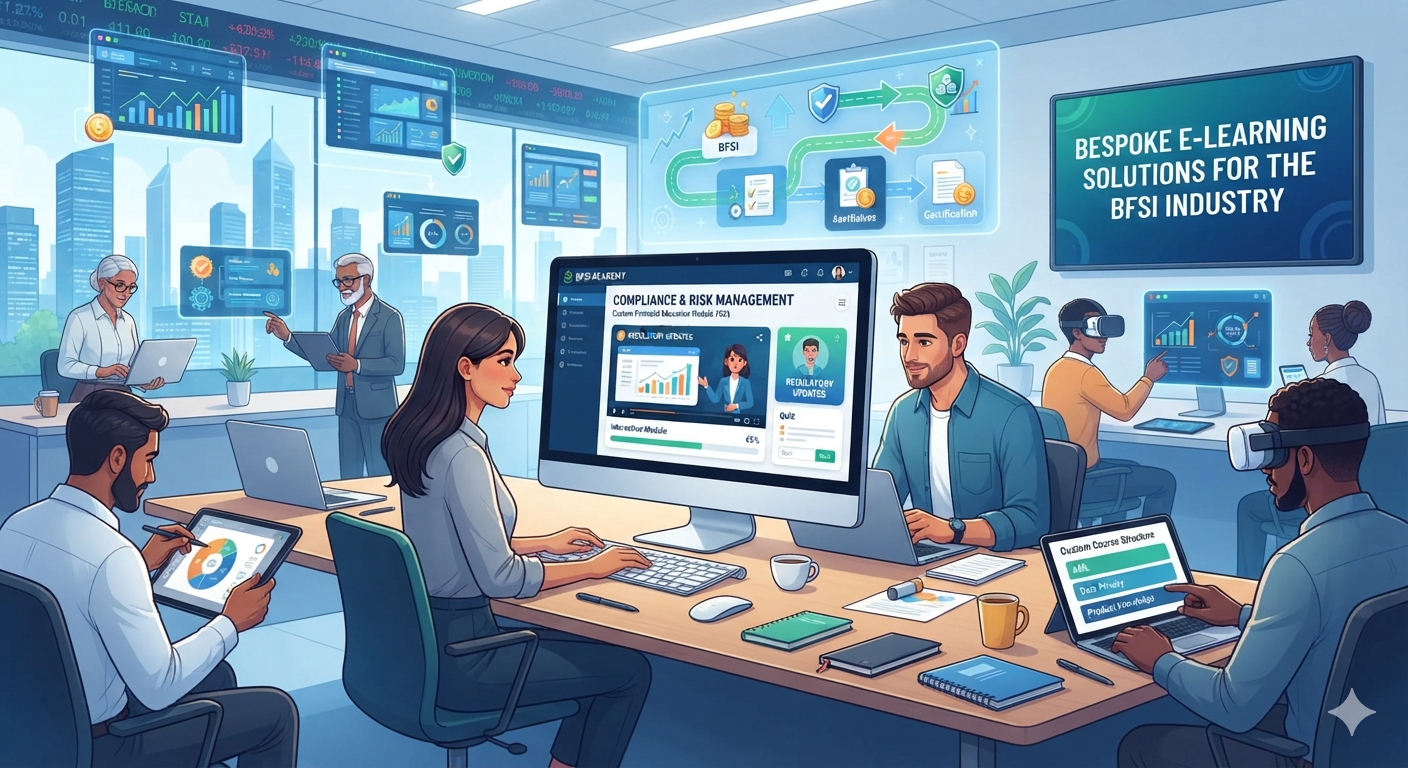
The BFSI sector continues to be one of the most regulated sectors in the world. But in 2026, the pace of change has accelerated like never before. Banks, insurance companies, NBFCs, fintech firms, mutual fund houses, and payment companies are adapting to new technologies, stricter regulations, evolving customer expectations, and increasingly sophisticated financial crimes.
These changes have also transformed the way organizations approach employee learning.
A few years ago, many institutions could rely on standard e-learning courses to satisfy compliance requirements. Today, that approach is proving inadequate. Employees need training that reflects their actual roles, internal systems, products, customers, and business risks. This is why custom e-learning development has become one of the biggest priorities for Learning and Development teams across the BFSI sector.
Learning Must Reflect the Way the BFSI Business Operates
Every financial institution follows regulations, but no two organizations operate in exactly the same way.
A private sector bank may have a completely different customer onboarding journey compared to a public sector bank. An NBFC processing vehicle loans follows different approval workflows than a housing finance company. Likewise, a health insurance provider handles claims differently from a general insurance company.
Yet many organizations still expect employees to learn using generic courses that explain only the regulations.
A standard Anti-Money Laundering e-learning course can explain suspicious transaction reporting, but it cannot teach employees how your organization identifies red flags, which systems they should use, who approves escalations, or how internal investigations are carried out.
This disconnect often creates confusion during real business situations.
Custom e-learning development for BFSI bridges that gap by training employees using the organization’s own processes, workflows, terminology, and policies. Learning becomes practical instead of theoretical.
Artificial Intelligence Is Changing Every Function
Artificial Intelligence is no longer an emerging technology within BFSI. It is becoming part of everyday operations.
Banks use AI to detect fraudulent transactions before customers even notice suspicious activity. Insurance companies automate document verification and claims processing. Wealth management firms analyze investment portfolios using predictive analytics, while customer support teams increasingly rely on intelligent virtual assistants to answer routine queries.
While these innovations improve efficiency, they also create new responsibilities for employees.
Can customer information be entered into public AI tools?
Should employees rely entirely on AI generated recommendations?
How should staff verify AI generated reports before sharing them with customers?
These questions cannot be answered through generic AI awareness programs because every organization uses AI differently.
Custom e-learning on AI topics for BFSI allows financial institutions to build organization specific AI training that reflects their technology landscape, governance framework, and internal policies.
Cyber Threats Have Become Far More Sophisticated
Cybersecurity training has also undergone a major transformation.
Only a few years ago, awareness programs focused mainly on identifying phishing emails and creating strong passwords. Today’s threats are far more advanced.
Cybercriminals now use artificial intelligence to generate convincing emails, clone executive voices, create fake documents, and even produce realistic video meetings.
One widely reported incident in 2024 involved a multinational finance company where fraudsters allegedly used deepfake technology during a video conference to impersonate senior executives. Believing the meeting was genuine, an employee authorised fund transfers worth millions before the deception was discovered.
Incidents like these highlight an important lesson.
Employees remember realistic scenarios far better than generic warnings. A branch employee, investment advisor, loan officer, and cybersecurity analyst all face different risks. Their training should reflect those differences.
This is where custom e-learning on Advanced Cybersecurity for BFSI creates measurable value.
Regulatory Changes Are Ever Evolving
Regulatory compliance has become a continuous process rather than an annual exercise.
Financial institutions regularly deal with changes relating to Anti-Money Laundering, Know Your Customer requirements, market abuse prevention, insider trading, data privacy, operational resilience, digital lending, and responsible use of Artificial Intelligence.
Every regulatory update requires employees to understand not only what has changed, but also how those changes affect their day to day responsibilities.
Updating classroom sessions across hundreds of branches can take months.
Updating a custom e-learning module can take days.
This flexibility enables organizations to deliver accurate information quickly while maintaining consistency across multiple locations.
For compliance teams, that speed has become a significant advantage.
One Course Cannot Train Everyone
Perhaps the biggest shift in 2026 is the recognition that employees perform very different jobs.
A relationship manager advises customers on financial products.
A claims processor evaluates insurance documentation.
A compliance officer investigates suspicious activities.
A treasury professional manages financial risk.
A customer service executive handles complaints through digital channels.
Expecting all of them to complete the same learning program rarely produces meaningful outcomes.
Modern custom e-learning development for BFSI focuses on role based learning journeys. Employees receive content that is directly relevant to their responsibilities, making the learning experience shorter, more engaging, and easier to apply on the job.
Organizations also report better knowledge retention because employees immediately recognize situations from their own work environment.
Employee Expectations Are Changing
Today’s workforce consumes information differently than previous generations.
Employees are accustomed to interactive apps, short videos, personalized recommendations, and intuitive digital experiences. Lengthy presentations filled with policy documents and legal language struggle to hold attention.
This has encouraged organizations to redesign learning experiences.
Instead of reading forty slides about fraud prevention, employees now work through realistic customer interactions, make decisions, receive immediate feedback, and understand the consequences of their choices.
Learning becomes an experience rather than a presentation.
That shift significantly improves engagement.
Data Is Driving Better Learning Decisions
Learning teams are no longer satisfied with completion reports.
Senior management wants to know whether training is reducing business risks.
- Which departments repeatedly fail assessments?
- Which compliance topics create the most confusion?
- Which branches require additional reinforcement?
- Are employees making fewer operational mistakes after completing training?
Custom e-learning integrated with LMS provides detailed insights that help organizations continuously improve both learning content and business performance.
Training becomes measurable rather than simply mandatory.
The Rise of Fintech Has Raised the Bar
Competition from fintech companies has also influenced employee learning.
Digital first financial companies introduce new products faster, adopt emerging technologies quickly, and continuously improve customer experiences.
Traditional banks and insurance companies are responding by accelerating digital transformation.
However, technology alone cannot improve customer experience.
Employees must understand new products, digital platforms, customer journeys, and internal processes before they can confidently support customers.
Custom e-learning for fintechs enables them to launch new products and services alongside structured employee training, ensuring that every customer interaction reflects the organization’s standards.
Learning Is Becoming a Business Strategy
The biggest change in 2026 is that custom e-learning development is no longer viewed as an HR initiative.
It has become a business strategy.
Leadership teams now expect learning programs to reduce compliance risks, improve operational efficiency, strengthen cybersecurity awareness, accelerate onboarding, enhance customer experience, and support digital transformation.
Training is no longer measured by the number of employees who completed a course.
It is measured by how effectively employees apply what they have learned.
That represents a fundamental shift in the way the BFSI industry views workplace learning.
Conclusion
The financial services industry is evolving faster than ever before, and employee learning must evolve alongside it.
Off the shelf e-learning courses for BFSI continue to play an important role in creating baseline awareness, but they cannot address the unique processes, technologies, products, and regulatory requirements that define individual organizations.
Custom e-learning development allows banks, NBFCs, insurance companies, fintech firms, asset management companies, and other financial institutions to create learning that mirrors their business reality. Employees gain practical knowledge, organizations strengthen compliance, and customers ultimately receive better service.
In 2026, the question is no longer whether BFSI organizations should invest in custom e-learning.
The real question is whether generic training can keep pace with the complexity of today’s BFSI environment.
To custom develop e-learning modules for BFSI get in touch with XLPro.