Introduction
The way organizations train their employees has changed significantly over the last few years. Corporate learning is no longer viewed as a routine HR activity or a compliance requirement. Today, organizations expect learning to improve productivity, accelerate onboarding, strengthen compliance, support digital transformation, and prepare employees for constant business change.
At the same time, the workplace has become more complex. Artificial intelligence is reshaping business processes, regulations continue to evolve, hybrid work has become the norm for many organizations, and employees are expected to learn new skills much faster than before. Generic training often struggles to keep pace because it cannot reflect an organization’s unique products, processes, customers, or culture.
This is why custom e-learning development services have become a strategic investment for corporates in 2026. Instead of delivering the same generic content to every organization, custom e-learning creates learning experiences built around specific business objectives, employee roles, internal policies, and real workplace situations.
Whether the goal is to onboard new employees, improve sales performance, strengthen compliance, train channel partners, or prepare teams to work responsibly with AI, custom e-learning helps employees gain practical knowledge that can be applied immediately on the job.
What Is Custom E-Learning Development?
Custom e-learning development is the process of designing and developing online training that is created specifically for one organization. Every aspect of the learning experience is tailored to match the organization’s business goals, branding, policies, products, systems, and employee roles.
For example, a banking organization may require training on anti-money laundering, insider trading, responsible AI, and customer due diligence. Similarly a manufacturing company may focus on operational safety, quality management, production workflows, and equipment handling. Even organizations operating in the same industry often have different approval processes, reporting structures, customer journeys, and internal systems.
By incorporating these business realities into the learning experience, organizations create training that is more engaging, more relevant, and easier for employees to apply. Rather than simply transferring information, custom e-learning helps employees develop confidence, improve decision making, and perform their roles more effectively.
Why Custom E-Learning Is Growing Rapidly in 2026
The demand for custom e-learning has increased dramatically because organizations now expect learning to deliver measurable business outcomes. Training is no longer about completing mandatory courses. It is about helping employees adapt to changing technologies, improving operational performance, reducing business risk, and building a future ready workforce.
Several important trends are driving this shift. Let us look at a few of them:
1.Artificial Intelligence Is Changing Workplace Learning
Artificial intelligence has quickly become part of everyday business operations. Employees across departments now use AI to improve productivity, analyze information, create content, automate routine work, and support decision making.
According to the LinkedIn Workplace Learning Report 2025, helping employees build AI related skills has become one of the highest priorities for Learning and Development teams worldwide. Organizations recognize that employees need more than basic AI awareness. They need practical guidance on using AI responsibly within their own workplace.
Generic AI courses rarely address organization specific requirements such as approved AI tools, confidential information handling, responsible AI policies, data privacy expectations, or internal governance frameworks. Custom e-learning allows organizations to incorporate these requirements into realistic workplace scenarios, helping employees understand how AI should and should not be used within their own business environment.
2.Organizations Continue to Invest in Employee Learning
Corporate learning continues to receive strong investment despite economic uncertainty. According to Deloitte’s Global Human Capital Trends research, organizations increasingly view continuous learning as a critical capability for building resilient and future ready workforces.
Similarly, Brandon Hall Group research consistently shows that organizations with mature learning strategies experience higher employee engagement, improved productivity, stronger innovation, and better talent retention.
3.Employees Want Learning That Matters
Modern employees expect learning that helps them solve real workplace challenges. Long presentations filled with generic information rarely maintain attention because employees struggle to connect them with their daily responsibilities.
Custom e-learning changes this experience completely. Employees learn through familiar business situations, actual customer interactions, company procedures, and realistic workplace decisions. Because the learning feels relevant, employees remain engaged and are more likely to apply their knowledge immediately.
4.Hybrid Work Requires Consistent Learning
Even though many organizations have returned to office based work, distributed teams continue to be common. Employees may work from regional offices, customer locations, manufacturing facilities, project sites, or home offices.
Maintaining consistency across such diverse work environments is challenging. Custom e-learning enables organizations to deliver standardized learning experiences regardless of employee location while ensuring that every learner receives the same guidance, policies, and business expectations.
5.Compliance Requirements Continue to Expand
Regulatory expectations continue to increase across almost every industry. Organizations regularly train employees on workplace ethics, prevention of sexual harassment, anti bribery, anti-money laundering, cybersecurity, data privacy, insider trading, ESG, responsible AI, and several industry specific regulations.
However, regulations alone are rarely enough. Employees also need to understand their organization’s reporting mechanisms, approval workflows, escalation procedures, and internal policies.
Custom e-learning bridges this gap by combining regulatory requirements with organization specific processes, making compliance training practical rather than theoretical.
6.Faster Onboarding Is Becoming a Business Priority
Organizations today cannot afford lengthy onboarding programs before employees become productive. Every additional week spent learning basic systems and processes delays business performance.
Custom onboarding modules and gamified employee induction introduce employees to company culture, organizational values, products, customers, internal systems, and workplace expectations through engaging digital learning experiences. This helps new hires build confidence faster while reducing the time required to become fully productive.
7.Continuous Learning Has Become Essential
Technology evolves rapidly. Products change. Regulations are updated. Customer expectations shift continuously.
Organizations therefore need learning that evolves with the business.
Custom e-learning provides this flexibility. Instead of replacing entire courses whenever policies or procedures change, organizations can quickly update relevant sections, ensuring employees always have access to current and accurate information while protecting their long term training investment.
Types of Custom E-Learning Solutions for Corporates
Custom e-learning supports almost every stage of the employee lifecycle and can be adapted to virtually any business function.
Employee onboarding remains one of the most common applications. Interactive onboarding programs introduce new hires to company culture, business values, organizational structure, products, systems, workplace policies, and expected behaviors, allowing employees to become productive much sooner.
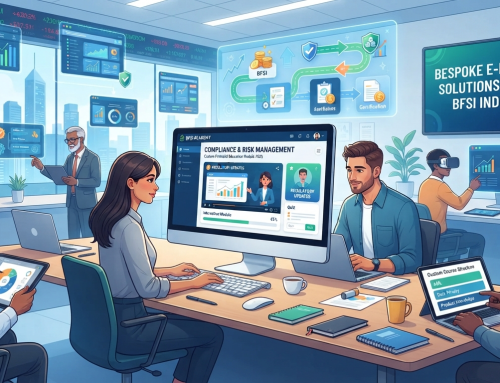
Compliance training is another major area where organizations invest in customization. Courses covering Prevention of Sexual Harassment, data privacy, anti money laundering, anti bribery, insider trading, information security, responsible AI, code of conduct, whistleblower policies, and ESG become significantly more effective when they reflect organization specific policies and reporting procedures instead of generic regulatory content.
Organizations also develop custom learning for sales enablement, product launches, customer service excellence, leadership development, technical training, manufacturing processes, software adoption, quality management systems, safety procedures, and channel partner education.
Because every course is aligned with specific business objectives, organizations achieve greater employee engagement while ensuring learning directly supports operational performance.
Benefits of Custom E-Learning Development
The greatest strength of custom e-learning is relevance. Employees learn faster when training reflects situations they actually encounter in their work. Instead of memorizing theoretical concepts, they develop practical skills that improve workplace performance.
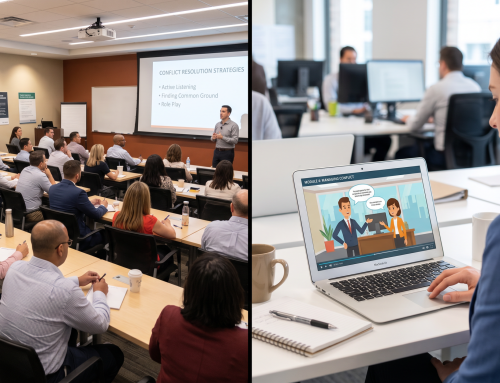
Interactive scenarios, branching decisions, simulations, videos, assessments, and gamified activities create engaging learning experiences that encourage employees to think critically rather than simply complete a course. Higher engagement generally leads to better completion rates, stronger knowledge retention, and greater confidence in applying new skills.
Custom learning also creates consistency across the organization. Whether employees work from headquarters, branch offices, factories, customer locations, or remotely, everyone receives the same high quality learning experience.
Organizations also benefit from greater flexibility. As products evolve, regulations change, or internal processes improve, custom courses can be updated quickly without replacing the complete learning program. This protects the organization’s investment while ensuring employees always receive accurate information.
Most importantly, custom e-learning aligns learning directly with business goals. Every module, scenario, assessment, and activity is designed to improve employee performance, reduce business risk, strengthen compliance, and support measurable organizational outcomes.
How AI Is Transforming Custom E-Learning Development
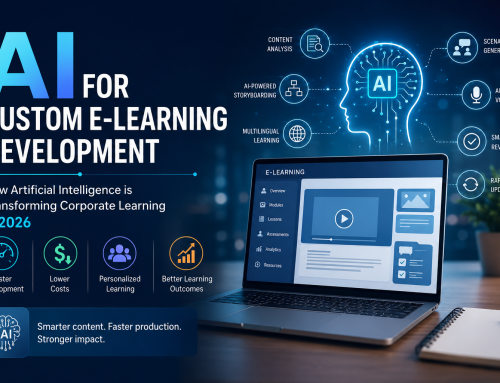
Artificial intelligence is transforming not only how employees learn but also how custom e-learning is developed. AI powered tools now assist with content analysis, storyboard creation, image generation, voiceovers, multilingual translations, subtitle creation, accessibility improvements, and quality reviews. Activities that previously required several days of manual effort can often be completed much faster.
For organizations, this means shorter development timelines, faster deployment of training programs, and lower production costs for repetitive tasks. It also becomes much easier to update courses whenever products, regulations, or business processes change, allowing learning to remain current without lengthy redevelopment cycles.
However, effective custom e-learning still depends on human expertise. AI can accelerate production, but it cannot fully understand an organization’s culture, learning objectives, compliance obligations, or business priorities. These elements continue to require experienced instructional designers, visual designers, developers, and subject matter experts.
Leading e-learning companies are therefore using AI as an accelerator rather than a replacement. At XLPro, AI is used to streamline research, storyboard drafting, visual asset creation, multilingual voiceovers, and quality assurance, enabling faster development without compromising learning quality. This allows our instructional designers and subject matter experts to focus on creating engaging scenarios, meaningful learner interactions, and business focused learning experiences that deliver measurable outcomes.
How to Choose the Right Custom E-Learning Development Partner
Selecting the right custom e-learning development partner is one of the most important decisions an organization can make. A well-designed course can improve employee performance, reduce compliance risks, and strengthen business outcomes. A poorly designed course, even with attractive visuals, often fails to achieve meaningful learning results.
The first factor to consider is industry experience. Every sector has unique regulations, terminology, workflows, and learning requirements. A development partner that understands your industry can build realistic scenarios and examples that resonate with learners.
Instructional design expertise is equally important. Effective learning is not about creating attractive screens or lengthy animations. It is about presenting information in a way that encourages employees to think, make decisions, and apply knowledge in real workplace situations. Scenario based learning, storytelling, interactive assessments, and learner engagement should form the foundation of every custom course.
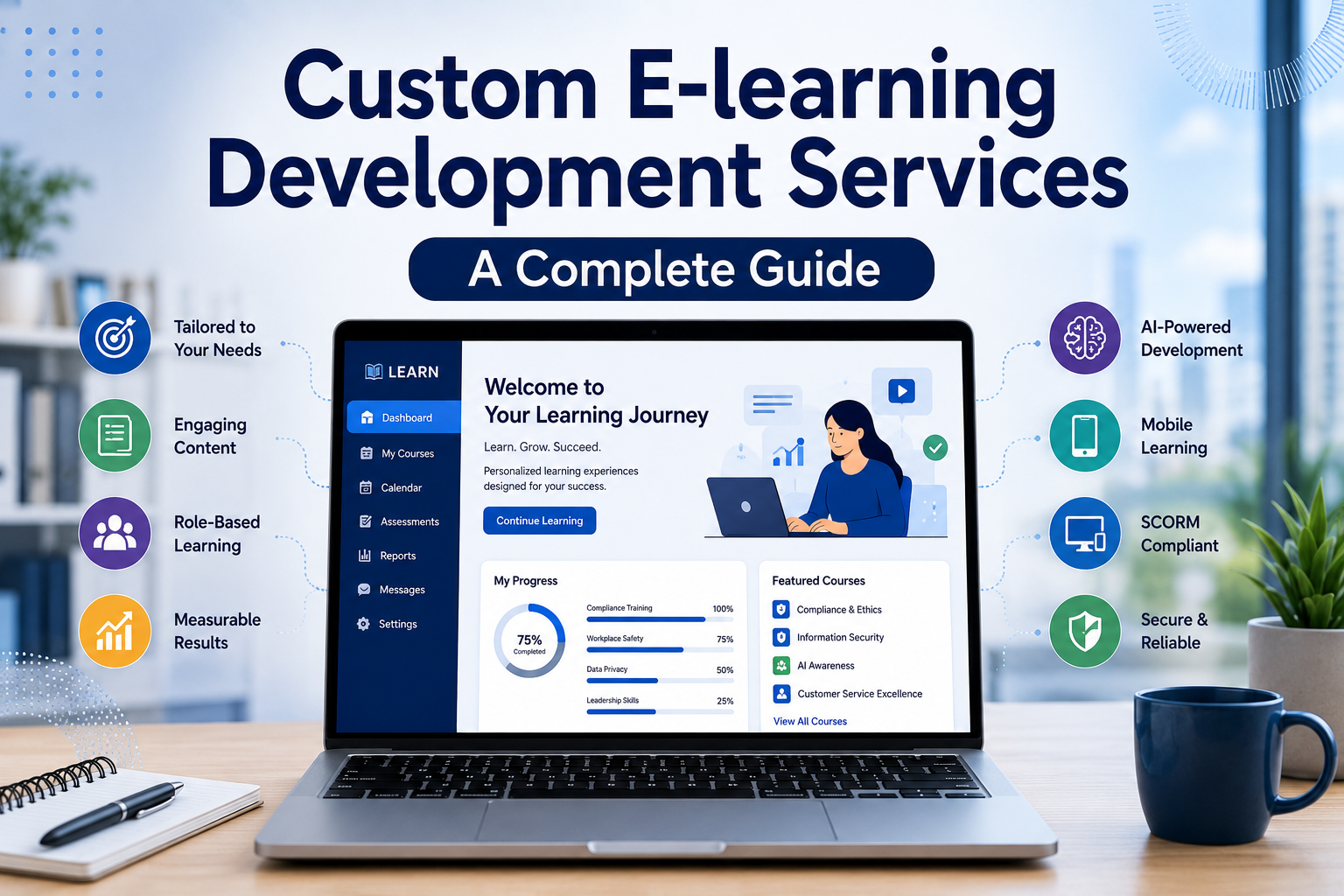
Organizations should also evaluate technical capabilities. Courses should be compatible with SCORM compliant Learning Management Systems, function seamlessly across desktops, tablets, and mobile devices, and support accessibility standards wherever required.
Scalability is another important consideration. The development partner should be able to support future course updates, multilingual versions, additional modules, and changing regulatory requirements without rebuilding the entire learning program.
Finally, look for a partner that takes time to understand your business before beginning development. The best custom e-learning projects start with asking the right questions, understanding business objectives, identifying learner challenges, and defining measurable learning outcomes.
Common Mistakes Organizations Make
Although many organizations recognize the value of custom e-learning, several common mistakes reduce its effectiveness.
One of the biggest mistakes is focusing only on visuals. Attractive graphics certainly improve the learner experience, but visuals alone do not create effective learning. Employees remember scenarios, decisions, and practical application far more than decorative animations.
Another common mistake is attempting to include every piece of available information in a single course. Employees do not need an online manual. They need learning that is focused, practical, and directly related to their role.
Many organizations also overlook learner analysis. Different audiences require different learning approaches. Frontline employees, managers, sales professionals, factory workers, customer service teams, and senior leadership all have different learning needs. Designing one course for everyone often reduces engagement.
Some organizations underestimate the importance of regular content updates. Regulations, business processes, products, and technologies continue to evolve. A course that remains unchanged for several years gradually loses relevance and effectiveness.
Finally, organizations sometimes view custom e-learning as a one time project rather than a long term learning strategy. The greatest value comes when digital learning becomes part of continuous employee development, supported by periodic updates, refresher modules, microlearning, and ongoing performance improvement initiatives.
The Future of Custom E-Learning Beyond 2026
Corporate learning will continue evolving rapidly over the next few years. Employees will increasingly expect learning experiences that are personalized, interactive, and available exactly when they need them.
Artificial intelligence will continue reducing development timelines while making it easier to create multilingual learning, generate visual assets, automate accessibility improvements, and personalize learning recommendations. However, organizations will continue relying on experienced instructional designers to ensure learning remains accurate, engaging, and aligned with business objectives.
Microlearning will become even more common as organizations deliver shorter, focused learning experiences that employees can complete during their normal workday. Instead of waiting for annual training programs, employees will receive continuous learning that supports changing business needs.
Scenario based learning will also become more sophisticated. Employees will increasingly learn through realistic workplace simulations that allow them to practice decisions without business risk. Compliance training, leadership development, customer service, cybersecurity, responsible AI, and sales enablement are all expected to benefit from this approach.
Organizations will also place greater emphasis on learning analytics. Rather than measuring only course completion, Learning and Development teams will increasingly evaluate business outcomes such as productivity improvements, reduced compliance incidents, faster onboarding, better customer satisfaction, and improved employee performance.
The organizations that invest in custom learning today will therefore be better prepared to respond to changing technologies, regulations, and workforce expectations tomorrow.
Conclusion
The workplace of 2026 demands learning that is relevant, practical, and closely aligned with business objectives and a well designed custom e-learning development exactly achieves that. The emergence of artificial intelligence has made custom e-learning development faster, more efficient, and more cost effective than ever before. Yet the most successful learning solutions continue to combine AI powered efficiencies with experienced instructional design, subject matter expertise, and a deep understanding of business needs.
As organizations continue investing in workforce development, custom e-learning is no longer a premium option reserved for large enterprises. It has become a strategic business investment that supports employee performance, strengthens compliance, accelerates onboarding, and prepares organizations for continuous change. Companies that invest in tailored digital learning today will be better positioned to build skilled, confident, and future ready workforces in the years ahead.