Artificial intelligence has changed the conversation around workplace learning.
Just a few years ago, discussions about AI in Learning and Development focused mainly on chatbots, recommendation engines, and adaptive learning platforms. Today, the conversation has shifted dramatically. AI is no longer influencing only how employees learn. It is transforming how learning itself is conceived, designed, developed, reviewed, updated, and delivered.
For organizations investing in custom e-learning, this represents one of the most significant changes the industry has experienced since the transition from classroom training to digital learning.
Traditionally, developing a custom e-learning course required weeks or even months of coordinated effort. Business stakeholders shared presentations, policy documents, SOPs, product manuals, or regulatory guidelines. Instructional designers converted this information into learning objectives and storyboards. Graphic designers created illustrations and layouts. Developers built interactions and assessments. Voice artists recorded narration, translators localized content, and quality teams reviewed every screen before deployment.
The process produced effective learning, but it was often resource intensive. Every revision required multiple teams to revisit the project, and even relatively small changes could delay deployment.
Artificial intelligence is changing that reality.
Rather than replacing the development process, AI is making every stage of it faster, more flexible, and more scalable. Tasks that once consumed days can now be completed in hours. Content updates no longer require rebuilding entire courses. Multilingual versions can be produced much more efficiently. Visual assets can be generated rapidly, and routine quality checks can be automated.
More importantly, AI is allowing organizations to respond to business change at a speed that traditional development methods struggled to match.
This transformation is happening at an important time. Businesses are introducing new products more frequently. Regulations are evolving continuously. Employees are expected to adopt new technologies almost as quickly as they appear. Skills that were relevant three years ago may already require updating.
Learning can no longer operate on annual development cycles. It has to move at the speed of business. That is precisely why AI for custom e-learning development guide for 2026 becomes important.
Why 2026 Marks a Turning Point
The past decade saw organizations steadily adopt digital learning, but much of that learning was still created using conventional production methods. Even when courses were delivered online, the underlying development process remained largely manual.
The emergence of generative AI has fundamentally changed this model.
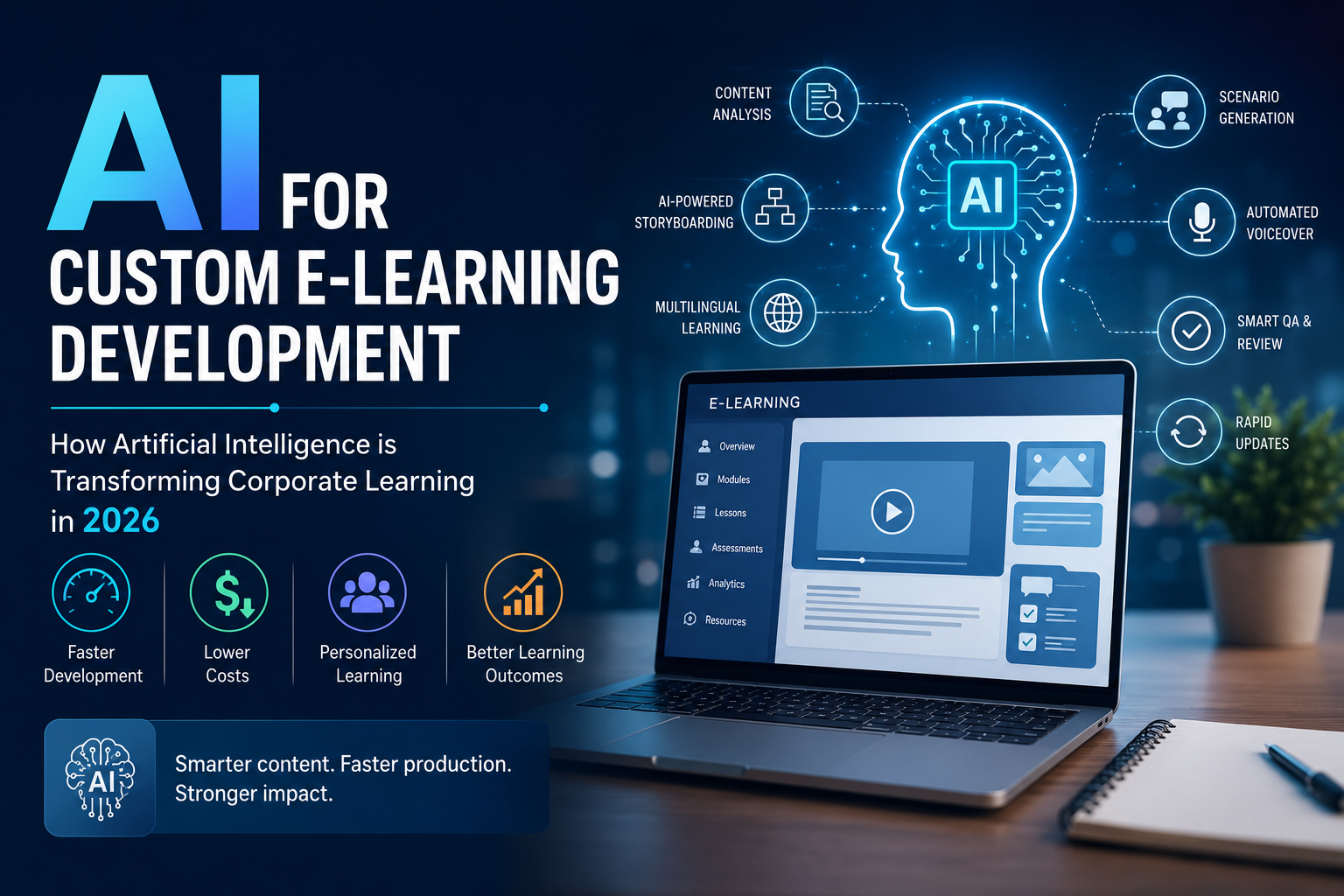
Instead of treating AI as another software application, leading e-learning companies are embedding it across the entire development workflow. Content can be analyzed automatically, complex documentation can be simplified, first draft storyboards can be generated in minutes, and repetitive production activities can be completed with far greater efficiency than before.
This shift is not simply about speed. It is changing the economics of custom e-learning development service.
Organizations that once hesitated to update learning because of time and cost constraints can now refresh courses more frequently. Compliance training can be revised when regulations change. Product training can evolve alongside new releases. Learning can become an ongoing business capability instead of a one-time project.
The impact is already visible across industries. Financial institutions are updating regulatory learning more frequently. Manufacturers are delivering shorter, targeted modules as production processes evolve. Technology companies are accelerating product enablement, while Global Capability Centers(GCCs) are creating continuous learning programs to keep pace with rapidly changing AI tools and workflows.
In each case, use of AI for custom e-learning development is helping organizations deliver learning when it is needed rather than months later.
From Linear Development to Intelligent Development
To appreciate how significant this shift is, it helps to understand how custom e-learning projects have traditionally been developed.
A typical project followed a linear sequence.
- Content was collected.
- Requirements were discussed.
- Storyboards were created.
- Designs were developed.
- Interactions were programmed.
- Voiceovers were recorded.
- Translations were completed.
- Testing was performed.
Only after these stages were finished could the course be deployed.
While effective, this approach also meant that delays at any stage affected the entire project. A single policy update might require storyboard revisions, visual changes, narration updates, additional testing, and another review cycle.
Artificial intelligence is transforming this linear model into a far more agile development process.
Instead of waiting for each activity to finish before the next begins, many tasks can now happen simultaneously.
- Content can be analyzed while learning structures are being proposed.
- Visual concepts can be created while scripts are refined.
- Voiceovers can be generated immediately after narration is approved.
- Accessibility checks and quality reviews can begin long before the course reaches final testing.
This parallel approach dramatically reduces production timelines without compromising consistency. The result is not simply faster delivery. It is a more responsive development model that can adapt as business priorities evolve.
AI Is Transforming Learning Before Development Even Begins
One of the least discussed but most valuable applications of AI occurs before the first storyboard is written.
Every custom e-learning project begins with information gathering.
Organizations typically provide a mixture of PowerPoint presentations, process documents, policies, technical manuals, product brochures, regulatory circulars, spreadsheets, meeting recordings, videos, and subject matter expert notes.
The challenge is rarely the availability of information.
The challenge is identifying what employees actually need to learn.
Artificial intelligence can analyze large volumes of content within minutes, identify recurring themes, cluster related concepts, summarize lengthy documentation, detect duplication, and organize information into logical categories.
For organizations with hundreds of pages of documentation, this significantly accelerates the discovery phase of the project.
Instead of manually reviewing every document, learning teams can begin with structured insights generated through AI and spend more time discussing learning priorities with business stakeholders.
This also improves collaboration.
Business experts no longer need to explain every detail from scratch. AI-generated summaries provide a common starting point, allowing discussions to focus on business outcomes rather than document interpretation.
Turning Information Into Learning
Collecting information is only the beginning. The real challenge lies in converting business knowledge into an engaging learning experience.
- Policies are written for compliance.
- Standard Operating Procedures are written for execution.
- Product manuals are written for reference.
None of these documents are written for learning.
Artificial intelligence is helping bridge this gap.
Large language models can reorganize technical information into structured learning topics, simplify complex language, recommend lesson sequences, generate first draft explanations, and suggest assessment questions.
What previously required several days of initial drafting can now be prepared much more quickly. This does not eliminate the need for stakeholder reviews or business validation. Instead, it shortens the journey from raw information to a structured learning framework.
For organizations, this means projects begin moving forward much sooner. For learners, it means the final course is built around clear learning pathways rather than simply presenting information screen after screen.
AI Is Changing How Storyboards Are Created
The storyboard has always been the blueprint of a custom e-learning course.
It defines what learners see, hear, read, decide, and practice.
Artificial intelligence is making storyboard development far more dynamic. Rather than beginning with a blank page, development teams can now generate multiple learning structures within minutes, compare different approaches, identify gaps, and explore alternative learner journeys before the first design is created.
AI can also recommend interactions based on the nature of the content.
- A decision-making topic may lend itself to a branching scenario.
- A software process may be better suited to a guided simulation.
- A compliance topic might benefit from workplace dilemmas instead of traditional multiple-choice questions.
These recommendations give development teams a stronger starting point while allowing greater time for refinement and stakeholder collaboration.
The storyboard therefore evolves from being a static document into an interactive planning tool that can be improved much more rapidly than before.
AI Across the Development Lifecycle
By the time a storyboard is approved, a traditional custom e-learning project moves into production. This is typically the most resource intensive stage of development. Graphic designers begin creating assets, developers build interactions, voice artists record narration, translators localize content, and quality teams prepare for multiple rounds of testing.
Artificial intelligence is transforming almost every one of these activities.
Rather than replacing established development practices, AI is helping organizations complete them faster, more consistently, and often at a significantly lower cost. The result is a development process that is not only more efficient but also better equipped to respond to changing business requirements.
Visual Design Is Becoming Faster and More Flexible
Visual design plays a critical role in learner engagement. Strong visuals simplify complex concepts, reinforce key messages, and help employees retain information for longer.
Traditionally, creating these visuals involved extensive manual work. Designers searched stock libraries, commissioned illustrations, edited photographs, created icons, and built custom graphics for every learning module.
AI has fundamentally changed this process.
Modern image generation tools can create high quality visual concepts in minutes based on simple design prompts. Characters, workplace environments, equipment, office layouts, industrial settings, customer interactions, and conceptual illustrations can all be generated rapidly.
This offers two major advantages.
- First, development teams spend less time searching for suitable imagery.
- Second, organizations are no longer limited by generic stock photographs that often fail to represent their workforce or business environment.
Instead, visuals can be tailored much more closely to the organization’s industry, branding, and learning objectives.
Designers continue to refine these assets, ensuring visual consistency, accessibility, and alignment with corporate identity, but the initial creative process has become significantly faster.
For organizations developing large learning libraries, these efficiencies can substantially reduce production timelines.
AI Is Helping Build Better Workplace Scenarios
Scenario based learning has become one of the most effective methods of improving employee decision making.
Employees rarely learn by memorizing definitions. They learn by making decisions that resemble situations they encounter in their daily work.
Developing realistic scenarios has traditionally required extensive collaboration between business stakeholders and learning teams.
AI now accelerates this process by helping generate multiple workplace situations from a single learning objective.
For example, if an organization is developing a course on customer complaints, AI can suggest conversations involving dissatisfied customers, delayed deliveries, pricing disputes, or service failures.
If the course focuses on cybersecurity, AI can generate different phishing attempts, social engineering situations, or data handling mistakes.
For compliance learning, AI can produce realistic workplace dilemmas involving conflicts of interest, whistleblowing, gifts and hospitality, procurement decisions, or insider information.
These scenarios provide an excellent starting point. Business stakeholders can then review them, modify them to reflect internal policies, and ensure they accurately represent situations employees are likely to encounter. This collaborative approach reduces development effort while producing learning that feels far more authentic than generic examples.
Multimedia Development Is Evolving Rapidly
Modern employees increasingly expect learning to resemble the digital experiences they encounter every day.
Videos, animations, motion graphics, interactive demonstrations, and conversational learning have become standard components of custom e-learning.
Artificial intelligence is dramatically simplifying multimedia production.
AI powered tools now assist with script refinement, storyboard visualization, video editing, subtitle generation, background enhancement, image restoration, and even automatic scene creation.
Organizations can therefore produce professional learning videos without relying on extensive studio production for every project.
This flexibility is particularly valuable when frequent updates are required.
A product feature changes; A regulation is amended; An internal process is revised.
Instead of recreating an entire video, many of these changes can now be incorporated much more efficiently.
As a result, multimedia learning is becoming easier to maintain throughout its lifecycle rather than only during initial development.
Multilingual Learning Is Becoming More Accessible
One of the biggest challenges for global organizations has always been localization.
Developing a course in one language is relatively straightforward.
Producing the same learning experience across multiple languages traditionally required separate translation agencies, voice recording sessions, subtitle creation, audio synchronization, and additional quality reviews.
Artificial intelligence is dramatically reducing this effort.
AI assisted translation platforms now produce high quality first drafts that preserve much of the original learning structure.
Speech synthesis technologies generate natural sounding narration in multiple languages.
Subtitle creation, timing, and synchronization can be completed automatically.
Organizations operating across different regions can therefore deploy learning much faster while maintaining consistency across languages.
This is particularly valuable in countries such as India, where organizations often deliver learning in English alongside regional languages to improve accessibility and learner engagement.
Human review remains important to validate terminology, regulatory references, and cultural nuances, but AI has substantially reduced the manual effort required to reach that stage.
Accessibility Is Improving by Design
Accessibility is no longer viewed as an optional enhancement.
Organizations increasingly expect learning to be usable by employees with diverse abilities and learning preferences.
Artificial intelligence is helping development teams improve accessibility much earlier in the production process.
AI tools can generate alternative image descriptions, identify color contrast issues, recommend simpler language, create captions automatically, convert narration into text, and identify potential accessibility gaps before courses are published.
These capabilities allow organizations to build more inclusive learning experiences without adding significant development time.
As accessibility regulations continue evolving globally, AI will play an increasingly important role in helping organizations meet both legal requirements and broader inclusion goals.
AI Is Accelerating Quality Assurance
Quality assurance has traditionally been one of the most time consuming stages of custom e-learning development.
Every screen must be checked for spelling, formatting, navigation, functionality, media synchronization, assessment accuracy, accessibility, and technical compatibility.
Large learning programs often require several review cycles before final approval.
The use of AI for custom e-learning development at the quality assurance stage helps in streamlining many of these activities.
Automated quality review tools can identify inconsistencies in terminology, detect broken links, highlight missing assets, review narration against on screen text, identify layout variations, and flag accessibility concerns before human testing begins. This reduces repetitive manual checking while allowing reviewers to concentrate on learning quality, business accuracy, and overall learner experience. The result is fewer production delays and more efficient review cycles.
AI Is Reducing Development Timelines
Perhaps the most visible impact of AI is the reduction in project timelines.
Several activities that previously happened one after another can now occur simultaneously.
- Content analysis begins while stakeholder discussions are still taking place.
- Visual concepts are created while storyboards are being refined.
- Voice generation starts immediately after scripts are approved.
- Translations begin alongside multimedia development.
- Automated quality checks run throughout production rather than only at the end.
This parallel approach fundamentally changes project delivery.
Organizations launching a new product, implementing a regulatory change, or rolling out a digital transformation initiative no longer need to wait several months before learning reaches employees.
Training can keep pace with business change. For many organizations, this speed has become just as valuable as the learning itself.
AI Is Reducing Costs in Smarter Ways
One of the most common questions organizations ask is whether AI reduces the cost of custom e-learning development.
The answer is yes, but not because AI simply replaces people.
Its greatest contribution lies in eliminating repetitive production activities.
- Research can be completed faster.
- Visual concepts can be generated more efficiently.
- Translations require less manual effort.
- Voiceovers can be produced rapidly.
- Quality reviews become more automated.
- Routine revisions take significantly less time.
Collectively, these efficiencies reduce the overall effort required to complete a project.
This allows organizations to invest more of their budget in activities that have a greater impact on learning outcomes, such as business analysis, learner research, realistic scenario design, performance support resources, and evaluation strategies.
The result is not simply lower development costs. It is better value from the overall learning investment.
AI Is Making Course Updates Easier
Corporate learning is rarely a one time activity.
- Policies evolve.
- Products change.
- Software is upgraded.
- Processes improve.
- Regulations are amended.
Traditional e-learning often struggled to keep pace because updates required significant redevelopment effort.
Artificial intelligence is changing this.
Development teams can now identify affected content much more quickly, revise scripts, regenerate visuals where required, update voiceovers, and republish learning within significantly shorter timeframes.
This is especially valuable for compliance training, product learning, cybersecurity awareness, and technology adoption, where information can become outdated within months.
Organizations no longer have to choose between outdated learning and expensive redevelopment.
Learning can evolve alongside the business.
AI as an Accelerator, Not the Destination
The most successful organizations are not adopting AI simply because it is new.
They are adopting it because it enables better learning outcomes.
At XLPro, AI has become an integral part of the custom e-learning development workflow. It helps accelerate content analysis, organize complex source material, support storyboard development, generate visual concepts, streamline multilingual production, and strengthen quality reviews. These efficiencies allow projects to move from concept to deployment much faster while ensuring that every learning solution remains aligned with the client’s business objectives, industry requirements, and workplace realities.
The real value of AI is therefore not automation alone.
It is the ability to deliver learning that is faster to develop, easier to maintain, more scalable across locations and languages, and better aligned with the pace of modern business.
As organizations continue investing in workforce capability, AI will become an essential part of the development process, not because it replaces established learning practices, but because it enables them to evolve.
The Future of AI Powered Custom Learning
Artificial intelligence has already transformed how custom e-learning is developed. The next phase of this transformation will be even more significant because AI is beginning to influence not just course development, but the entire learning ecosystem.
Organizations are moving beyond digitizing training. Their focus is shifting towards creating learning experiences that are continuous, personalized, measurable, and closely aligned with business performance.
This represents one of the biggest opportunities for Learning and Development teams in the coming years.
AI Is Making Learning More Personalized
One of the biggest limitations of traditional corporate training has always been its “one size fits all” approach.
Employees working in different departments often complete the same learning program regardless of their experience, responsibilities, or existing knowledge.
An experienced sales manager and a newly hired sales executive may receive identical product training.
A cybersecurity specialist and an HR executive may be assigned the same awareness program.
While this approach is administratively simple, it is rarely the most effective way to develop skills.
Artificial intelligence is helping organizations move away from standardized learning journeys.
Modern learning platforms increasingly analyze learner behaviour, assessment performance, previous training history, job roles, certifications, career aspirations, and even preferred learning formats to recommend relevant learning experiences.
Instead of assigning every course to every employee, organizations can create learning pathways that adapt to individual requirements.
A new employee may receive foundational learning.
An experienced employee may move directly to advanced topics.
Managers may receive leadership scenarios.
Compliance teams may receive role specific regulatory learning.
The learning experience becomes far more relevant because employees spend less time completing unnecessary content and more time building skills that support their current responsibilities.
As organizations continue investing in AI enabled learning ecosystems, personalization will become one of the defining characteristics of corporate learning.
Learning Will Become Continuous Instead of Periodic
For many years, corporate training followed a calendar.
Employees completed onboarding during their first few weeks.
Compliance training was assigned annually.
Leadership programs were conducted once or twice a year.
Beyond these events, learning often remained disconnected from everyday work.
Artificial intelligence is changing this model.
Learning is becoming continuous.
Instead of waiting for scheduled training sessions, employees can receive knowledge when they actually need it.
A relationship manager preparing for a customer meeting may access a short product refresher.
A procurement employee reviewing a supplier contract may revisit conflict of interest guidance.
A manager preparing for a difficult performance discussion may complete a brief coaching module before the meeting.
This concept of learning in the flow of work has existed for several years, but AI is making it much more practical.
By understanding learner behaviour and business context, AI can recommend relevant resources exactly when they are needed.
For organizations, this means learning becomes part of daily work rather than an activity separated from it.
Data Will Drive Better Learning Decisions
Learning Management Systems have traditionally generated large amounts of data.
Completion rates.
Assessment scores.
Time spent on courses.
Certificates earned.
While useful, these metrics rarely explained whether learning was actually improving business performance.
Artificial intelligence allows organizations to analyse learning data at a much deeper level.
Patterns begin to emerge.
Which topics consistently produce lower assessment scores?
Where do learners abandon a course?
Which departments require additional reinforcement?
Which compliance topics result in repeated mistakes?
Which learning resources improve workplace performance most effectively?
These insights help Learning and Development teams continuously improve learning rather than simply reporting completion statistics.
The conversation therefore shifts from learning activity to learning effectiveness.
Responsible AI Training Is Becoming a Business Priority
As organizations adopt AI across different business functions, another learning requirement is rapidly emerging.
Employees need guidance on how to use AI responsibly.
Generative AI has made it remarkably easy to create reports, presentations, emails, software code, marketing content, and business analyses.
However, without appropriate governance, these same tools can expose organizations to significant operational and compliance risks.
Confidential information may be uploaded to public AI platforms.
Customer data could be shared unintentionally.
AI generated content may contain inaccuracies or bias.
Employees may unknowingly rely on AI outputs without proper verification.
These risks highlight why AI literacy is no longer sufficient.
Organizations increasingly require Responsible AI training that explains how AI should be used within their own operating environment.
Custom e-learning plays an important role here because it allows organizations to incorporate their own AI policies, approved platforms, governance frameworks, data handling requirements, approval processes, and acceptable use guidelines into the learning experience.
As AI regulations continue evolving globally, this type of organization specific learning is expected to become a standard component of corporate training.
Every Industry Will Follow a Different AI Journey
Although AI is becoming a common business technology, its adoption varies significantly across industries.
Consequently, learning requirements also differ.
Financial institutions require learning that supports regulatory compliance, fraud prevention, customer due diligence, market conduct, and responsible AI adoption.
Manufacturing organizations focus on predictive maintenance, quality assurance, automation, and operational safety.
Healthcare organizations require learning around clinical decision support, patient confidentiality, diagnostics, and ethical AI use.
Technology companies need continuous learning as development platforms and AI tools evolve rapidly.
Global Capability Centers continue investing heavily in AI upskilling across finance, HR, legal operations, procurement, analytics, customer support, and software engineering.
This diversity reinforces an important point.
There is no universal AI learning program.
Every organization requires learning that reflects its own business priorities, operational processes, regulatory environment, and workforce challenges.
That is precisely why demand for custom e-learning continues to grow despite the rapid advancement of AI technologies.
Choosing an AI Enabled Custom E-Learning Partner
As AI becomes increasingly common, many learning providers now promote AI powered development.
For corporate buyers, this creates a new challenge.
How do you distinguish meaningful AI integration from marketing claims?
Rather than asking whether a development partner uses AI, organizations should ask how AI is used throughout the development lifecycle.
- Does AI help analyze complex source material?
- Can it accelerate storyboard development?
- How does it support multilingual learning?
- How are visuals generated and reviewed?
- What quality assurance processes remain in place?
- How are data privacy and confidential business information protected during development?
- Can the organization update courses quickly when business requirements change?
The answers to these questions reveal far more than a simple statement that AI is being used.
The strongest development partners combine AI with structured development methodologies, industry expertise, and a clear understanding of business objectives.
At XLPro, AI has become an integral part of this approach. It supports research, content organization, storyboard development, multilingual production, visual asset generation, accessibility improvements, and quality assurance, enabling projects to move more efficiently from concept to deployment. Every solution, however, continues to be developed around the client’s unique business processes, workforce requirements, and learning objectives rather than relying on standardized AI generated content.
This balanced approach allows organizations to benefit from AI driven efficiency while maintaining the quality expected from a custom learning solution.
The Future of Custom E-Learning
The next few years are likely to bring even greater changes.
- AI tutors will provide immediate learner support.
- Learning platforms will become increasingly adaptive.
- Content updates will happen almost in real time.
- Virtual simulations will become more immersive.
- Learning analytics will become more predictive.
- Organizations will identify skill gaps before they begin affecting business performance.
- Courses will become modular, allowing content to be updated in smaller sections rather than rebuilding complete programs.
- Voice, video, translation, accessibility, and content creation technologies will continue improving at an extraordinary pace.
Yet despite these advances, one principle will remain unchanged.
Organizations do not invest in custom e-learning because they need courses. They invest because they need employees who can perform better.
Technology may accelerate development, but business value is created only when learning improves decisions, strengthens compliance, increases productivity, reduces risk, and supports organizational growth.
AI is becoming one of the most powerful enablers of that transformation.
Conclusion
Artificial intelligence is redefining what is possible in custom e-learning development.
From analyzing complex source material and accelerating storyboard creation to generating multimedia assets, simplifying localization, improving accessibility, and enabling faster updates, AI is making every stage of development more efficient.
At the same time, organizations are beginning to expect more from learning itself.
Training is no longer measured by completion rates alone. Business leaders want learning that shortens onboarding, improves employee performance, strengthens compliance, supports digital transformation, and enables faster adoption of new technologies.
Artificial intelligence is helping organizations achieve these objectives by making learning more agile, scalable, and responsive to change.
The organizations that will benefit most are not those that simply adopt AI tools. They are those that integrate AI thoughtfully into a structured custom e-learning development process, combining technology with business understanding, learning strategy, and continuous improvement.
For corporate learning leaders, the conversation has therefore shifted.
The question is no longer whether AI will transform custom e-learning development.
That transformation is already underway.
The real opportunity lies in using AI to create learning that keeps pace with business change, equips employees with relevant skills, and delivers measurable business outcomes. Organizations that embrace this approach today will be better prepared for the workforce challenges of tomorrow.