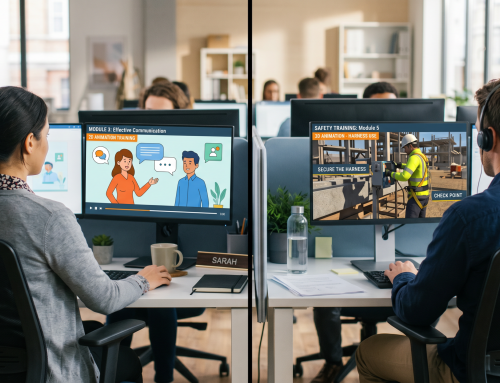
Artificial Intelligence (AI) is reshaping industries across the globe, and corporate learning is no exception. Over the past few years, AI has evolved from a futuristic concept into a practical business tool that is helping organizations improve productivity, reduce costs, and accelerate content creation.
One area experiencing significant transformation is animated e-learning video development.
Traditionally, creating animated training videos required extensive effort from instructional designers, scriptwriters, graphic designers, animators, voice artists, and quality assurance teams. While these professionals remain essential to producing high-quality learning experiences, AI is dramatically changing how much of the development process is performed.
Today, AI-powered tools can assist with script creation, voice generation, visual design, animation, localization, content updates, and learner personalization. As a result, organizations can develop engaging animated training videos faster and more cost-effectively than ever before.
However, AI is not replacing instructional design or creativity. Instead, it is enhancing human capabilities and enabling learning teams to focus more on strategy, learning effectiveness, and learner engagement.
In this article, we’ll explore how AI is transforming animated e-learning video development and what it means for organizations investing in digital learning.
The Growing Demand for Animated E-Learning Videos
Organizations increasingly rely on animated videos for:
- Employee onboarding
- Compliance training
- Cybersecurity awareness
- Product education
- Leadership development
- Soft skills training
- Process training
Animated videos are popular because they:
- Simplify complex topics
- Improve learner engagement
- Support remote workforces
- Enhance knowledge retention
- Deliver consistent learning experiences
At the same time, organizations are under pressure to create more learning content, update training more frequently, and reduce development costs.
AI is helping address these challenges.
The Traditional Development Process
Before understanding AI’s impact, it’s useful to examine the conventional development workflow.
Creating an animated e-learning video typically involves:
- Training needs analysis
- Content gathering
- Instructional design
- Script writing
- Storyboarding
- Graphic design
- Voiceover recording
- Animation production
- Quality assurance
- LMS deployment
Each stage requires specialized expertise and significant effort.
AI is now assisting in many of these areas, making development faster and more efficient.
1. AI-Assisted Script Writing
Scriptwriting is often one of the most time-consuming stages of e-learning development.
Instructional designers traditionally spend hours:
- Researching content
- Organizing information
- Writing narration
- Creating scenarios
AI tools can now generate first-draft scripts within minutes.
These tools can help:
- Summarize source materials
- Generate training outlines
- Create learning objectives
- Suggest scenarios
- Draft narration scripts
For example, a compliance policy document can be converted into a training script much faster with AI assistance.
What AI Does Well
- Content summarization
- Draft creation
- Topic organization
- Language simplification
What Humans Still Need to Do
- Verify accuracy
- Add context
- Create meaningful learning experiences
- Ensure instructional effectiveness
AI accelerates script development but does not replace instructional design expertise.
2. Faster Storyboarding
Storyboarding traditionally requires instructional designers and visual designers to map narration against screen visuals.
AI tools can now assist by:
- Suggesting visual concepts
- Generating scene descriptions
- Creating rough storyboard layouts
- Recommending visual sequences
This speeds up the planning phase and allows development teams to focus on refining learning experiences rather than starting from scratch.
3. AI-Generated Voiceovers
One of the most visible AI advancements is synthetic voice technology.
Modern AI voice tools can produce natural-sounding narration in multiple languages and accents.
Benefits include:
- Reduced production costs
- Faster turnaround times
- Easy script revisions
- Consistent voice quality
- Multilingual support
Previously, even minor script changes often required re-recording voiceovers.
With AI-generated narration, updates can be implemented almost instantly.
Important Consideration
For high-impact learning programs, professional human voice actors may still provide superior emotional expression and authenticity.
However, AI voices have become remarkably effective for many corporate training applications.
4. Accelerating Visual Asset Creation
Creating custom visual assets has traditionally required graphic designers and illustrators.
AI image-generation tools can now assist with:
- Character concepts
- Background designs
- Icons and illustrations
- Visual references
- Design variations
These tools help designers rapidly explore creative options and reduce repetitive design work.
Instead of replacing designers, AI enables them to work more efficiently and focus on higher-value creative tasks.
5. Enhancing Animation Production
Animation production often represents one of the most labor-intensive stages of development.
AI-powered animation tools can automate tasks such as:
- Character lip-syncing
- Facial expressions
- Motion generation
- Gesture creation
- Scene transitions
What once required extensive manual effort can now be completed much faster.
This reduces production timelines while maintaining visual quality.
As AI animation tools continue to improve, organizations can expect increasingly sophisticated automated animation capabilities.
6. Personalizing Learning Experiences
One of AI’s most exciting contributions is personalization.
Traditional animated training videos typically deliver identical content to every learner.
AI enables more adaptive learning experiences by:
- Analyzing learner performance
- Identifying knowledge gaps
- Recommending relevant content
- Adjusting learning pathways
Future animated learning experiences may dynamically adapt based on:
- Learner role
- Experience level
- Assessment performance
- Training history
This creates more relevant and effective learning journeys.
7. Simplifying Localization and Translation
Global organizations often need training content in multiple languages.
Traditional localization can be expensive and time-consuming.
AI significantly accelerates:
- Translation
- Subtitle generation
- Voiceover localization
- Text adaptation
Organizations can quickly create multilingual versions of animated training videos and reach global audiences more efficiently.
This is particularly valuable for compliance training and employee onboarding programs delivered across multiple regions.
8. Improving Accessibility
AI is helping organizations create more inclusive learning experiences.
AI-powered tools can automatically generate:
- Closed captions
- Subtitles
- Audio descriptions
- Language translations
These capabilities improve accessibility for learners with diverse needs and support compliance with accessibility standards.
9. Accelerating Content Updates
Training content often requires frequent updates due to:
- Regulatory changes
- Policy revisions
- Product enhancements
- Process updates
Traditionally, updating an animated video could be a lengthy process.
AI simplifies revisions by enabling:
- Rapid script updates
- Automated narration regeneration
- Faster visual modifications
Organizations can keep training content current with significantly less effort.
10. Learning Analytics and Insights
AI is also improving how organizations measure learning effectiveness.
AI-powered analytics can help identify:
- Learner engagement patterns
- Drop-off points
- Knowledge gaps
- Performance trends
These insights allow L&D teams to continuously optimize training content and improve learning outcomes.
Rather than relying solely on completion rates, organizations can gain deeper visibility into learner behavior.
Benefits of AI in Animated E-Learning Development
Organizations adopting AI-assisted development can achieve several advantages.
Faster Development
AI reduces time spent on repetitive tasks and accelerates content production.
Lower Costs
Automation decreases development effort and production expenses.
Greater Scalability
Organizations can create more learning content without proportionally increasing resources.
Easier Updates
Training content remains current through rapid revisions.
Improved Localization
Global deployment becomes more efficient and cost-effective.
Enhanced Personalization
Learners receive more relevant and targeted learning experiences.
What AI Cannot Replace
Despite its impressive capabilities, AI is not a substitute for effective instructional design.
Successful learning still requires human expertise in:
Learning Strategy
Understanding business objectives and learner needs.
Instructional Design
Creating meaningful learning experiences that promote retention and behavior change.
Storytelling
Developing compelling narratives and scenarios.
Subject Matter Expertise
Ensuring content accuracy and relevance.
Creative Judgment
Making design decisions that support learning outcomes.
AI works best when combined with human creativity and educational expertise.
The Future of AI-Powered Animated Learning
The future of animated e-learning development will likely involve even deeper integration of AI technologies.
Emerging capabilities may include:
- Real-time content generation
- Conversational learning experiences
- AI tutors and coaches
- Personalized animated scenarios
- Adaptive storytelling
- Interactive AI-driven simulations
These innovations will make learning experiences more dynamic, responsive, and learner-centric.
Organizations that embrace AI thoughtfully will be better positioned to deliver scalable and effective workforce learning programs.
Conclusion
Artificial Intelligence is transforming animated e-learning video development by making content creation faster, more efficient, and increasingly personalized. From scriptwriting and voiceovers to animation, localization, and analytics, AI is helping organizations produce high-quality training content at unprecedented speed and scale.
However, the most effective learning experiences still depend on strong instructional design, compelling storytelling, and human creativity. AI should be viewed as a powerful development partner rather than a replacement for learning professionals.
Organizations that combine AI-powered tools with expert instructional design can create engaging animated e-learning videos that improve learner engagement, accelerate development timelines, reduce costs, and drive meaningful workplace performance improvements.
As AI technology continues to evolve, its role in corporate learning will only grow, opening new possibilities for creating smarter, more adaptive, and more impactful training experiences.